Dr Hélène Njoto
AAHP Coordinator; Researcher at Ecole française d’Extrême-Orient (EFEO), Jakarta
This webinar series offers comprehensive introductory lectures in Archaeology and Art History of Southeast Asia with a focus on the pre-Modern to the Modern periods. Covering topics from major Southeast Asian land and maritime civilisations over the last 1000 years, these lectures highlights the rich cultural heritage of ancient Southeast Asian societies. The archaeology component covers the great civilisations and kingdoms such as Angkor, Dai Viet, Ayutthaya, Majapahit, and Malacca. It provides a broad overview of the rise and dissolution of the major ancient powers in Southeast Asia and explain the interconnectedness of the region.
The art and architecture history component addresses the material culture and technical knowledge of Southeast Asian societies. It emphasises the specificities of ceramics, stone sculpture, textile and textile representation, bronze art, manuscript illuminations, as well as stone and wooden architecture productions and appreciation in the region. It covers their circulation through trade and religious networks from the second millennium AD to the early 20th century with an emphasis on the Hindu and Buddhist civilisations, as well as the making of Islamicate material culture from the 13-15th centuries onwards.
This webinar series is designed for undergraduates engaged in Southeast Asia art history and archaeology curriculum as well as junior college or polytechnic students with interests in heritage and history. The series is also appropriate for educators and members of the public.
This webinar series was convened by Hélène Njoto and Noel Hidalgo Tan.
Webinar 1, July 6, 2021
How well do you know your neighbours? Dr. Hélène Njoto and Dr. Noel Hidalgo Tan kickstart a journey through Southeast Asia’s past, from its early human migrations to the grandeur of its empires. Discover how art and architecture reveal the dynamic interplay of cultures and influences.
In this introductory lecture, we set the stage by giving an overview to the archaeology and art history in Southeast Asia, from ancient times to the recent past. Southeast Asia is characterised by its remarkable diversity – in both continental and archipelagic landscapes, cultures and languages. We start by examining why and how this region has become a hotbed of human migration over the past 50,000 years, giving rise to the major cultural traditions that we know today. We then turn our focus sharply into the 1,000 years – the time of the great empires – and how they interacted with each other over time. We will move to the pre-colonial period and look at how historical evidence has helped us understand several Southeast Asian cultures over time. Finally, we will analyse the impact of colonialism and Islam across this region and identify where the legacy remains today. We will browse through the main artistic and architectural inventions of the different polities presented, and see how the exogenous philosophies and influences shaped the art and material culture of Southeast Asia, introducing the rich and varied topics addressed in this Webinar Series.
Highlights
Tuesday, 6 July 2021 – The Temasek History Research Centre’s Head and Deputy Chief Executive of the ISEAS – Yusof Ishak Institute, Dr Terence Chong, kicked off its webinar series on the archaeology and art history of Southeast Asia by introducing the speakers and series conveners Dr Hélène Njoto (Ecole française d’Extrême-Orient, Jakarta) and Dr Noel Hidalgo Tan (SEAMEO Regional Centre for Archaeology and Fine Arts). The series comprises 12 webinar lectures by 17 speakers and will take place from July 2021 to January 2022.
Today’s introductory lecture focused on the three primary themes of the series – Southeast Asia, archaeology, and art history and material culture studies. Dr Tan set the stage by inviting participants to ponder the nature of Southeast Asia through the remarkable diversity of its landscapes, biological forms, peoples and cultures. Dr Njoto pointed out that the idea of “Southeast Asia” as a geographic region is a fairly recent innovation, and revealed the other ways the region has been imagined at different points in time, such as “Further India” or “Greater India”, “Indochina”, “the East Indies”, “Insulindia”, and more recently as a part of a single overarching region along South, East and Southeast Asia’s maritime channels known as “Monsoon Asia”.
Dr Tan briefly outlined the archaeology of Southeast Asia, beginning with the arrival of modern humans into the region from around 70,000 years ago, to major climate changes starting from the end of the Holocene around 14,000 years ago leading to a rise in sea levels and population movements within, and into, Southeast Asia. 4,000 years ago these changes saw the emergence of agriculture and permanent settlements. Technological innovations such as ceramics production and metallurgy further accelerate the move from nomadic hunter-gatherer lifestyles. By the first millennium CE, the presence of exotic and non-local items in archaeological sites across the region suggest networks of exchange over long distances.
Concentrations of power and resources in different locations eventually led to the development of early states during the first part of the first millennium CE, which can be seen today in the remnants at My Son in Vietnam and Sambor Prei Kuk in Cambodia which become precursors to the larger empires that rose from the end of the first millennium. Dr Tan then highlighted some of the major empires which will be subjects of focus in the upcoming lectures such as Dai Viet, Ayutthaya and Malacca.
In the second part of this lecture, Dr Njoto introduced notions of historiography and paradigm shifts, stressing the importance of archaeology and material culture studies in a region where textual sources are relatively scarce. She mentioned recent ground-breaking archaeological discoveries (e.g. ceramics, nautical technologies and beads) which allowed for major revisions about the Indianisation paradigm. She outlined key points about recent finds which brought evidence of early bilateral exchanges and local Southeast Asian agency in the first centuries BCE into what was previously considered a millennium-long historiographical gap between a prehistorical period and the acknowledged start of Indianisation in the first centuries of the Common Era. She spoke of the reasons behind the relatively late attention given to archaeology and material culture, such as the persistence of a colonial agenda until about the 1960s and the lack of accessibility of some historical areas up until the 1990s for political reasons. While introducing the speakers of the coming art history and material culture lectures, Dr Njoto highlighted other fields where local agencies created techniques and artistic forms that were singularly Southeast Asian, such as in architecture, ceramics, stone sculpture/reliefs, textiles and bronze art. Dr Njoto concluded this lecture by introducing key points about the Islamisation of Southeast Asia, a paradigm less often addressed but also subject to revisions. This allowed her to mention three other of the coming lectures on mosque architecture, Islamic material culture and museum collections and last on Malay manuscripts illuminations.
Many questions were raised by the audience, some more specifically about sites or materials mentioned in the lecture, others about institutions providing teachings in archaeology in Southeast Asia and Singapore. Other questions pertained to more historiographical and chronological issues such as how to address the notion of origin and influence and whether some early Southeast Asian polities should be placed in the proto-historical period. Unfortunately, not all questions could be addressed due to a lack of time.
The webinar was attended by 320 participants from Singapore and the region.

AAHP Coordinator; Researcher at Ecole française d’Extrême-Orient (EFEO), Jakarta

AAHP Coordinator; SEAMEO Regional Centre for Archaeology and Fine Arts (SEAMEO SPAFA), Bangkok
Webinar 2, July 21, 2021
Join Dr. Heng Piphal on a fascinating expedition into the depths of the Angkor civilization. From its majestic monuments to the bustling life within its capital, uncover the stories of a society that thrived through innovative statecraft and a vibrant urban culture. Learn about the profound connections between the city and its provinces, and the legacy that continues to inspire.
This talk (re)introduces the Angkor civilisation from its formation in the 9th century to its political collapse in the 15th century based on recent archaeological research. Angkor was one of the largest empires to ever rule a large portion of Mainland Southeast Asia. Much is known about its cult of “god-king”, political successions, great monuments, and religions. This talk will focus on the city of Angkor, urban infrastructure (monuments, water management structures, roads, etc.) and its associated social aspects, the people who lived there, and most importantly, the relationship with its provincial centers.
Highlights
In this webinar, Dr Heng Piphal delved into the city of Angkor, urban infrastructure and its associated social aspects, the people who lived there, and most importantly, the relationship with its provincial centers.
Wednesday, 21 July 2021 – The ISEAS – Yusof Ishak Institute hosted a webinar on “Angkor (c. 9th-15th century): People, Monument, City, and Statecraft” by Dr Heng Piphal. Dr Heng is a postdoctoral researcher at Northern Illinois University and has worked and researched extensively on the archaeology of Cambodia. The webinar was part of the Temasek History Research Centre’s Archaeology and Art History Programme of Southeast Asia and moderated by one of the programme’s conveners Dr Noel Hidalgo Tan.
The Khmer Empire is one of the best-known ancient kingdoms of Southeast Asia, and a fitting starting point for the Archaeology and Art History of Southeast Asia webinar series. Dr Heng focused on the idea of the ‘city’, from which the name Angkor is derived from, and discussed Angkor as an ancient state, an “un-lost city”, and being “lost in the city”.
Dr Heng first gave an overview of the history of Angkor, located between the Tonle Sap and Phnom Kulen in modern-day northwest Cambodia. Recent research suggests that the empire’s population is estimated at between 500,000 to 900,000 people, while the urban core – the ‘city’ – supported a population between 76,000 – 150,000. He also pointed out how Angkor, like cities of today, can be described in terms of physical and social infrastructure. Relying on a variety of sources such as evidence from bas-reliefs, archaeological data, artistic visualisations and text, Dr Heng showed how different forms of infrastructure manifested. These include an extensive road system, both within the walled enclosures and connecting to provincial centres in modern-day Thailand and Laos; state-run education (religious schools) and health care (hospitals or arogyaśālās); and how various religious festivals spur the mass movement of peoples to and from urban centres – much like how it continues today.
Dr Heng suggested that cities – both ancient and modern – are sensory-overloading experiences. Ordinary citizens of the Khmer empire visiting the capital would be overwhelmed by the denseness of the population, belittled by the towering glittering buildings, and confused by the gridded layout of the city. Conversely, the later colonial powers could not conceive how a recently defeated population could be responsible for the grand ruins in the forest and attributed their origin to a long-lost civilization. Today, Angkor continues to astound as a global tourist attraction and a Unesco World Heritage Site.
A lively question-and-answer session followed, with participants asking about the hydraulic management and decline of Angkor, the location of centres of production, and aspects of daily life in ancient Cambodia. The webinar attracted over 270 participants, mostly from Singapore and Southeast Asia.

Postdoctoral fellow/graduate faculty scholar, Center for Southeast Asian Studies and Department of Anthropology, Northern Illinois University
Webinar 3, August 4, 2021
Explore the fascinating realms of Southeast Asian art with experts Dr. Natalie Ong and Dr. Sandra Sardjono. Explore the depth of relief sculptures that decorate ancient temples and the silent stories told by the region’s dress and textiles. Learn how these art forms serve as a window into the vibrant societies of the past, shedding light on the interplay between art, society, and the natural environment. Witness the beauty and complexity of a region where art is not just seen but felt.
Introduction to Southeast Asian Relief Sculpture, by Dr Natalie S.Y. Ong
What is relief sculpture and where may we find them? Using examples from our rich Southeast Asian past up until the arrival of Islam, this lecture presents an overview of the characteristics that distinguish reliefs from other types of art, and the role that the natural and built environments play in the production and appreciation of reliefs. Techniques of relief-making will also be identified, and, while most artistic output can be described as decorative, different types of reliefs serve different purposes. But more than just ornamental or functional, reliefs can also be extremely informative. Some of the ways historians and archaeologists employ the study of reliefs to gain new knowledge will be explored, especially useful with cultures that have oral traditions or whose writings were not made on permanent remains. The lecture will discuss various methods of tracing origins and the circulation of ideas, determining the chronology of undated sites and objects, and even inferring certain unspoken social practices and attitudes, in order to reveal aspects of the past which have been lost to time.
Dress and Textile Representation in Southeast Asia, by Dr Sandra Sardjono
Organic materials such as textile and wood are vulnerable and do not survive well in the tropical climate of Southeast Asia. Are some evidence available from the early historical period? Despite the dearth of actual textiles remain, imprints of textiles can be found on sculptures and temple reliefs; many of them can be linked to materials preserved outside Southeast Asia. This lecture will provide an overview of the ancient maritime trade routes that were responsible for the circulation of these textiles. It will explore some visual evidence on sculptures that provide clues to the style of dress and patterns popular in different periods, and conversely, dress and patterns that can be used to date sculptures that may have lost their original context. Finally, this lecture will discuss the role of textiles in Southeast Asia as political currency, how they establish cultural identity, and the evolution of textile technique as local responses to prestigious trade textiles.
Highlights
In this double webinar session, Dr Natalie Ong and Dr Sandra Sardjono presented on the topics of relief sculpture as well as dress and textile representations in Southeast Asia. These art forms serve as records of the high degree of artistic sophistication reached by some polities and societies in both Continental and Island Southeast Asia of the past.
Wednesday, 4 August 2021 – The ISEAS – Yusof Ishak Institute hosted a webinar titled “Introduction to Southeast Asian Relief Sculpture & Dress and Textile Representation in Southeast Asia” by Dr Natalie Ong (independent scholar) and Dr Sandra Sardjono (founder of the Tracing Patterns Foundation, California), both art historians who specialise in Indonesia and Southeast Asia. The webinar was part of the Temasek History Research Centre’s Archaeology and Art History Programme of Southeast Asia and was moderated by one of the programme’s conveners Dr Hélène Njoto..
The double webinar session kicked off with Dr Natalie Ong’s general introduction about relief sculpture in Southeast Asia. Before delving into the complexities of topics represented by Southeast Asian sculptors, Dr Ong first carefully defined the visual and technical aspects of relief sculpture and their specificities in the region. She clarified the distinction between high and low reliefs and the different types of surfaces used, indicating that most reliefs were found on architectural surfaces, with coloured stucco plaster. Dr Ong further explained the difference between the two methods of sculpture, the additive and the subtractive, which is the most common method, used for example by the Borobudur temple sculptors, as shown in the famous temple’s Hidden Base.
Showing a few unfinished reliefs from this temple, she demonstrated how historical information could be retrieved from studying reliefs, such as sculpting methods and social organisation among expert craftsmen, some specialising in flora, others in objects, architecture or human figures. Delving into further sociological aspects about this art form, she showed how historians could gain knowledge about the circulation of ideas, social practices and attitudes. Taking an example from a Ramayana relief she demonstrated how experts were able to understand the early existence of a localised version of the Indian Epic dating from as early as the 8th c. Finally, Dr Ong showed how social hierarchy as well the position of women in society was subtly reflected in these reliefs, through subtle arrangement of scenery, the use of proportions as well as objects such as jewellery.
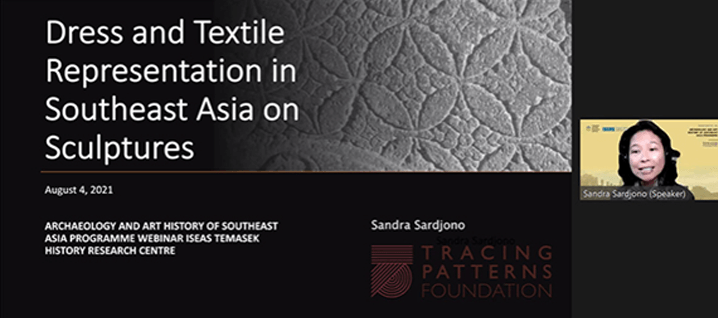
In the second part of the webinar session, Dr Sandra Sardjono gave a presentation on dress and textiles and their representations on relief sculpture and statuary in Southeast Asia. Dr Sardjono introduced her presentation by reminding the audience about the significance of these sculpted representations as an exceptionally rich source of information, given the scarcity of textual and material evidence. The few known textual sources, mostly Chinese, all agree on textile being used as a currency for trade and barter, and high end imported textiles being signs of prestige and gifts at official ceremonies. After a brief overview on the most common types of textile traditions in the region (Warp and Weft Ikat, Songket and Batik), Dr Sardjono invited the audience to explore the variety and ubiquity of Southeast Asian motifs, such as the circles and dots pattern, the lion, floral and pearl roundels, flowers, fauna, hamsa/goose, patola and coin motifs, some circulating through various media (textiles but also ceramics, architecture décor, furniture, etc.).
This richly illustrated demonstration brought further evidence of textile as a precious source of information on the dynamism of the Spice route trade network between China and India primarily. Furthermore, the examples shown demonstrated that this region was also connected to polities and production centres as far as the Middle East, as seen from the Sasanian (223-651) Pearl-roundel pattern sculpted in Central-Java. The overlapping circles motif popular in 14th c. Java and found in Egypt is another example of the connectedness of Southeast Asia during the early historical period.
A lively question-and-answer session followed, with participants asking about the antiquity, geographical provenance and meaning of specific motifs sculpted in relief or weaved in textiles, about the transfer of motifs from one material to another, about how other sources such as inscriptions can complement reliefs sculpture, and other questions regarding techniques. The webinar attracted over 250 participants, mostly from Singapore and Southeast Asia.

Post-doctoral fellow, KITLV Royal Netherlands Institute of Southeast Asian and Caribbean Studies, Leiden and Singapore

Founder and President, Tracing Patterns Foundation, Berkeley, USA
Webinar 4, July 18, 2021
Embark on a journey with Mr. Ye Myat Lwin to the ancient cities of Bagan and Mrauk U, where the grandeur of Myanmar’s past comes alive through its Buddhist monuments and sophisticated urban architecture. From the iconic temples of Bagan to the strategic trade hub of Mrauk U, uncover the stories of empires that flourished through art, religion, and commerce in the heart of Southeast Asia.
Bagan and Mrauk U were the most glorious cities of Myanmar and now the most attractive archaeological sites of the western part of Southeast Asia in 2nd millennium AD. Bagan is located in the heart of Myanmar. It has become the most popular archaeological site for tourism and pilgrimage in Myanmar with over 3,000 ancient Buddhist monuments built from the 11th to 13th centuries AD. Most monuments in Bagan are Buddhist temples and most of them are decorated with mural paintings inside and stucco carving outside. Earlier Buddhist iconography in Bagan is heavily influenced by Pala of Southeast India and it was gradually localised in later periods. Apart from the religious monuments, the rectangular walled city and its citadel also allow us to study medieval urban life. Mrauk U is the westernmost metropolitan city of early modern Southeast Asia, which survived between 15th and late 18th centuries AD before being invaded by Ava of central Burma. Mrauk U was a maritime trade city and used the silver coins which were inscribed with the title of the kings in Arakanese and Persian. It had strong relationships with the Mughals, Portugese and Dutch. It is known among archaeologists for its sophisticated water management system and urban architecture which can be compared with western cities such as Lisbon and Amsterdam. The temples, stupa and city were constructed in stone. This presentation will explore the different types of architectural remains and Buddhist iconography through the age in Bagan and introduce the archaeological evidence of trade, communities, landscape, religious and urban architecture of early modern Mrauk U.
Highlights
In this webinar, Mr Ye Myat Lwin explores the different types of architectural remains and Buddhist iconography through the age in Bagan and introduce the archaeological evidence of trade, communities, landscape, religious and urban architecture of early modern Mrauk U.
Wednesday, 18 August 2021 – The Temasek History Research Centre’s Archaeology and Art History Programme of Southeast Asia focused on Myanmar in this webinar presented by Mr Ye Myat Lwin, an Erasmus scholar in Archaeological Material Science at the Aristotle University of Thessaloniki and the Sapienza University of Rome. Mr Ye was formerly of the Department of Archaeology and National Museum in Myanmar, and worked in the Bagan Archaeological Museum. The webinar was moderated by programme co-convener Dr Noel Hidalgo Tan.
Mr Ye Myat Lwin introduced two major kingdoms that existed in Myanmar during the second millennium CE: Bagan (9-13th c) and Mrauk U (15-18th c), both distinct in character with influence reaching through Mainland Southeast Asia and the Bay of Bengal respectively.
As a Unesco World Heritage site built in the dry zone of central Myanmar, Bagan is the better-known of the kingdoms with over 3,000 monuments dotting the landscape. The kingdom reached its peak between the 11-13th centuries before falling to the Mongols, and most of the temple-building activity was concentrated during the 12th and 13th centuries. As there are very few absolute dates for the temples, most of the monuments in Bagan are dated by style, and Mr Ye showed how stupa styles and temple construction evolved over time.
Another interesting feature of the temples in Bagan are the wall murals depicting scenes from the life of Buddha or the Jataka tales (stories from the previous lives of the Buddha). Over 400 temples in Bagan contain mural paintings that have been likened to Himalayan art, but unlike Himalayan art do not depict the more frightening form of deities..
Shifting the focus to Western Myanmar, Mr Ye drew attention to the kingdom of Arakan, and its capital Mrauk-U which was established in the 15th century in present-day Rakhine state. At its peak, the Arakan Kingdom controlled the eastern coastline of the Bay of Bengal, including parts of Bangladesh. The name Arakan can be traced to Roman records from the 2nd century CE.
Mr Ye noted that certain aspects of Mrauk-U including stupa construction style and the use of Mahanayanist iconography (particularly the figure of Amitayus) set the kingdom apart from other parts of Myanmar. Mr Ye suggests that these features were attempts to replicate styles found at Weithali, a former Arakanese capital that existed in the later part of the first millennium.
Mrauk-U’s location in the Bay of Bengal made it an influential trading partner, with evidence of trade with the Persians, Portuguese and the Dutch. Both Islamic and Pali names can be found in Mrauk-U inscriptions and coins, in Persian, Bengali and Arakanese scripts. In its heyday, the city contained architectural features including a palace, numerous city gates, moats, and hydrological features. Noting the complexity of Arakan’s landscape, an account from a 17th century Jesuit priest said that Venice should actually be called a second Mrauk-U.
These two kingdoms highlight how ancient Myanmar interacted with the wider world, as centres of Buddhism and, in the case of Mrauk-U, as a part of the widening global trade network. In the Question and Answer session, Mr Ye fielded a range of questions about architectural and art styles in Bagan and Arakan, networks of exchange between Arakan and the Persian and Indian world, and the etymology of Arakan as a source of silver in the ancient world. The webinar attracted 169 participants, mostly from Singapore and Southeast Asia.
Postgraduate student, Aristotle University of Thessaloniki, Greece
Webinar 5, September 2, 2021
Dr. Farouk Yahya takes us into the mystical world of Malay illustrated manuscripts, delving into the enchanting realm of magic and divination. These ancient texts, adorned with intricate illustrations, unlock secrets of Malay art, society, and spiritual practices. Discover how these manuscripts serve as a unique window into the cultural fusion and distinctive traditions of the Malay world.
Manuscripts are handwritten texts (prior to the advent of printing, books and documents had to be written and copied by hand). Malay manuscripts were written in a form of Arabic script known as Jawi. The texts contained in these manuscripts cover a broad range of topics such as religion, literature, legal codes, medicine and correspondence.
Apart from texts, manuscripts may also contain visual and artistic elements such as illustrations, diagrams and decoration. This lecture will look at illustrated Malay manuscripts, with a focus on those relating to the topic of magic and divination. These manuscripts are important for our understanding of Malay art, especially drawing and painting. They also provide us with an insight into life in Malay society in the past.
Highlights
In this webinar session, Dr Farouk Yahya spoke on manuscripts illustrations in Southeast Asia, focusing on manuscripts produced for magic and divination practices in the Malay world. This presentation stressed how although Malay illustrations and manuscripts combine motifs and beliefs inspired from neighbouring regions, their function and practices having found unique expressions in the Malay world.
Thursday, 2 September 2021 – The ISEAS – Yusof Ishak Institute hosted a webinar titled “Malay illustrated manuscripts with a focus on images of magic and divination” by Dr Farouk Yahya, a Research Associate in the Department of History of Art and Archaeology from the SOAS University of London. Dr Yahya is an art historian specializing in Islamic art in Southeast Asia and the Malay world. The webinar was part of the Temasek History Research Centre’s Archaeology and Art History Programme of Southeast Asia and was moderated by one of the programme’s conveners Dr Hélène Njoto..
Dr Yahya started with a general introduction to the materiality and antiquity of manuscripts in Southeast Asia. He described the different materials used to produce manuscripts (palm leaves, dluwang, tree bark, paper, etc.) emphasizing their vulnerability. Due to the perishable nature of these materials, early manuscripts are very rare in the region, the earliest surviving example dating from the 14th century, not long after the coming of Islam in the region. However, Dr Yahya showed a few examples from statuary and epigraphy dating as early as the 5th century onwards that bring evidence of very early manuscripts usage in the region, as seen in a seated Maitreya figure from the 9th c. CE holding a manuscript.
Turning to aspects of language and script, Dr Yahya explained how Indic and Arabic scripts were adapted by Southeast Asian societies to write vernacular languages, Malay being one of them. The Malay language was used not only by Malays but by a vast range of maritime Southeast Asian populations. He showed how the codex format was adopted in the region, including copies of the Qur’an, which could be richly decorated or illuminated but seldom illustrated. Only a few genres are illustrated such as devotional works like Al-Jazuli’s Dala’il al-khayrat, a text widespread in Southeast Asia addressing such themes as the tomb layout of Prophet Muhammad and his two companions Abu Bakr and Umar in Medina. Dr Yahya took this example to introduce the second part of his presentation: the localisation of motifs and themes. He showed how Southeast Asian versions of this famous text had more elaborate vegetal or floral motifs, a different palette of colours, as well as specific Malay architectural features such as slumping curved roof finials.
Dr Yahya further showed how Malay literary manuscripts were rarely illustrated, with a few exceptions such as Hikayat Hanuman, the Tale of Dewa Mandu and the Tale of Indra Mengindra. On the contrary, Magic and Divination manuscripts held numerous fascinating illustrations serving different purposes, such as requests to transform something or a situation by calling on superhuman forces (magic) or to predict future events by using techniques such as astrology or numerology (divination).
Taking a few examples from 19th century manuscripts, Dr Yahya presented a few representative features from talismanic designs used to exorcise evil spirits, and the way these talismans were used. Another emblematic motif found in this type of manuscript is the Rotating Naga technique. This motif was found all across the region, but it is known to have been more often represented in Southeast Asian manuscripts for the purpose of seeking auspicious times for specific actions (war, housebuilding, travelling, etc.). Dr Yahya explored another well-spread motif represented in calligrams using Arabic script: the Lion of Ali. He demonstrated how this original Middle Eastern motif found a proper Southeast Asian expression. In this popular Southeast Asian talisman, Ali was seldom mentioned and the lion was referred to as a tiger, an animal present in the region, unlike its fellow feline.
A lively question-and-answer session followed, with participants asking many questions about the content and use of the manuscripts for cursing, medical treatment, religious purposes, today’s practices of the rituals mentioned, genres represented (panji, syairs, hikayats, etc.), as well as motifs and themes (Tiger of Ali, naga, calligrams), and regional influences between Sunni and Shia traditions. Attendees also asked about materiality and conservation, the identity of scribes, the differences between Malay and Christian manuscripts, and finally the context of their collection during the colonial times. The webinar attracted over 200 participants, mostly from Singapore and Southeast Asia.
Research Associate, Department of History of Art and Archaeology, School of Arts, SOAS University of London
Webinar 6, September 15, 2021
Discover the Sultanate of Malacca’s grandeur with Dr. Nasha bin Rodziadi Khaw, from its foundation by Parameswara to its zenith as a maritime dominion. Explore the sultanate’s architectural, cultural, and political landscape through a blend of historical narratives and archaeological evidence, illuminating the enduring legacy of Melaka in Southeast Asian history.
The Sultanate of Malacca is a confederation of several Malay states which began as a trading outpost at the estuary of the Malacca river. Parameswara, who founded the Malacca ruling dynasty at the end of the 14th century CE, gradually pacified nearby coastal and riverine settlements such as Muar, Beruas and Klang. This gave Malacca an advantage over the distribution of local resources, especially tin and rainforest products. In the successive decades, the network of ports and polities under Malaccafurther expanded to Southeast Sumatra and the rest of the Malay Peninsula, giving the main port a monopoly over certain products as well as control over the movement of peoples and goods. By the second half of the 15th century CE, Malacca became a thalassocratic state with written laws, taxation, and foreign diplomatic relations, as well as an established system of rulers, nobles, chieftains and administrators. Long after the fall of Melaka port to the Portuguese, successor states such as Perak, Johor and Pahang still retain the old vestiges in the forms of their jurisprudence, court rituals and social hierarchy. This lecture reviews the archaeological and historical sources on Melaka, based on which its culture, economic and political system will be discussed.
Highlights
In the sixth webinar of the series, Dr Nasha bin Rodziadi Khaw reviews the archaeological and historical sources on Melaka, based on which its culture, economic and political system.
Wednesday, 15 September 2021 – The ISEAS – Yusof Ishak Institute hosted a webinar titled “Reviewing The Sultanate of Melaka: Archaeology, History and Culture” by Dr Nasha bin Rodziadi Khaw, a Senior Lecturer at the Centre for Global Archaeological Research at Universiti Sains Malaysia. The webinar was part of the Temasek History Research Centre’s Archaeology and Art History Programme of Southeast Asia and was moderated by one of the programme’s conveners Dr Hélène Njoto.
The Sultanate of Malacca’s emergence as a confederation of coastal polities in the 15th century marked a new phase of maritime dominance in the region. Prior to Malacca, Dr Khaw pointed out the existence of other polities in maritime Southeast Asia, such as ancient Kedah and Langkasuka on the west and east coast of Peninsular Malaysia respectively.
The Sultanate of Malacca, with its centre at the mouth of the Malacca River along the Straits of Malacca, is held as the benchmark for Malay cultural, economic and political achievement. Despite its cultural significance, Dr Khaw explained that physical remains from the Sultanate period are scarce due to its short period of development, continuous subsequent occupation, and the perishable nature of the city’s infrastructure.
Dr Khaw outlined our knowledge of Malacca from various historical sources, such as the Chinese Ming Dynasty histories, accounts from Portuguese such as the Suma Oriental by Tome Pires and later Malay writings such as the Salalatus Salatin or the Genealogy of Kings. Collectively, they paint a picture of a thalassocratic power which relied on the control of movement and distribution of goods, ultimately through the main port of Malacca.
Dividing the sultanate’s 111-year history into five phases, Dr Khaw outlined the history of Malacca starting with Parameswara, a Majapahit noble who at the end of the 14th century CE was expelled from Palembang and Singapura before moving northwards in the Malay Peninsula to Muar and Bertam. Dr Khaw explained the strategic decisions that led to these movements. Facing incursions from Majapahit and Siam, Parameswara established his court at Bertam and eventually Malacca.
The second phase, during the reign of Megat Iskandar Shah (1414-1424), saw more assertive action towards the establishment of Malacca as a trading centre by securing recognition from China and breaking the monopoly held by the Pasai Sultanate in northern Sumatra by attracting Muslim traders. During the third and fourth phase spanning some 60 years and five rulers, Malacca increased its dominance over neighbouring regions, while at the same time establishing an administrative system and adopting Islam. By the middle of the 15th century, Malacca controlled the Straits of Malacca, and territories at the eastern coast of Sumatra and most of the Malay Peninsula. It was powerful enough to cease giving tributes to Siam.
Malacca’s decline at the beginning of the 16th century was marked by infighting and mismanagement by the noble class and the rise of rival ports in Java and Aceh which culminated in conquest by the Portuguese who came to take over the polity. Territories that were once under Malacca came under the control of Siam, Aceh and the Johor-Riau Empire.
Despite its short period of existence, Dr Khaw explained that Malacca’s significance in Malay historiography and consciousness can be attributed to the wealth of historical evidence available, which also provide details such as the geographic layout of the city and its administration of the state by the Sultan and Bendahara as well as its taxation policies that ensured the Malacca became an attractive port of trade to both the east and west.
Various questions were fielded by Dr Khaw for the rest of the webinar, including questions about the nature of Malacca’s control over its sphere of influence, the lack of industry and dependence on trade as a primary cause of Malacca’s fall, as well as questions about archaeological remains located in and around Malacca. The webinar was attended by 220 participants, largely from Singapore and Malaysia.

Senior Lecturer, Centre for Global Archaeological Research, Universiti Sains Malaysia
Webinar 7, October 5, 2021
Prof Chotima Chaturawong discusses the fascinating journey of Hindu and Buddhist architecture across Southeast Asia, tracing its evolution from the Indianisation period to indigenisation. Explore how these ancient religions influenced iconic temples, adapting to local styles and materials, and discover the unique architectural landmarks that blend tradition with regional innovation.
This lecture will address the spread of Hindu and Buddhist religious architecture in Southeast Asia by highlighting two different periods: indianisation and indigenisation. It begins with an introduction to Hindu and Buddhist architecture during the Indianisation period from the 1st to the 7th/9th centuries, and proceeds with Buddhist architecture in Myanmar and Thailand during the indigenisation period from the 19th to the 20th centuries. The former includes the architecture of the Khmer during the pre-Angkor period, of the Cham in My Son, of the Javanese in the Dieng Plateau, of the Pyu in Beikthano and Sriksetra, and of the Mon in Thaton and Nakhon Pathom. The latter focuses on Buddhist architecture of the Mon and Burmese in Moulmein and Mandalay; of so-called Burmese in Chiang Mai and Lampang, Thailand; and of the Siamese (central Thai) in Bangkok. This lecture will show how architectural forms and techniques circulated and were (re)invented in the vast Southeast Asian continental and maritime area, to shape the internationaly known iconic temples of Southeast Asia.
Highlights
In this webinar session, Prof Chotima Chaturawong addressed a long time-span phenomenon that contributed to shaping Southeast Asia’s landmark Hindu and Buddhist monuments in both Continental and Island Southeast Asia.
Tuesday, 5 October 2021 – The ISEAS – Yusof Ishak Institute hosted a webinar titled “Indianisation and Indigenisation of Southeast Asian Hindu and Buddhist Architecture” by Professor Chotima Chaturawong, an architecture historian who specialises in Myanmar and Southeast Asia. The webinar was part of the Temasek History Research Centre’s Archaeology and Art History Programme of Southeast Asia and was moderated by one of the programme’s conveners, Dr Hélène Njoto.
Professor Chotima Chaturawong began with a brief introduction to the arrival of Hinduism and Buddhism in Southeast Asia. Both religions spread mainly through trade networks and followed monsoon winds. She then gave an overview of the periodisation of Hindu and Buddhist architecture in the region and the characteristics of each period. The Early Indianisation period spreading from 1st to 7th century in the mainland, one of the main Indian influence characteristics being square plan single-cell structures with or without a circumambulatory gallery.
However, Professor Chotima noted that temples were never strict imitations of their Indian counterparts. On the contrary, they presented many variations. They were also the result of reinterpretations and the expression of local knowledge. These variations also depended on the materials available locally (brick in mainland Southeast Asia and mainly stone in insular Southeast Asia). The so-called « Golden period » showcased more maturity from the 8th to the 10th century in insular Southeast Asia through examples from Central Java, and from the 9th to 13th century in the mainland such as in Khmer architecture of the Angkor period, Cham architecture and the architecture of the Pagan Dynasty.
Drawing from her own research, Professor Chotima gave a few examples from 19th and 20th centuries central Thai, Burmese, Mon, and Pa-o Buddhist architecture. She showed how Thai and Burmese are heirs to Theravada Buddhism being neighbours and sharing an ancient history at their border. She demonstrated how in Bangkok, Buddhist temples developed a division between public areas (Buddhavasa) and private areas for monks (Sanghavasa) during the reign of King Rama IV (. 1851-1868). In the public area, buildings were aligned along an axis, a feature unknown in India. Another example of localisation and reinterpretation of Indian (in this case Srilankan) architecture was taken from King Mindon’s reign (r. 1853-1878): Royal monastic compounds where the central monastery of the abbot was surrounded by smaller monasteries, a feature inspired by Sri Lanka. Other examples are Mon monasteries in Moulmein, Myanmar and a Pa-o monastery in Lampang, northern Thailand which were built by teak merchants. Professor Chotima observed that Burmese, Mon, and Pa-o monastery floor plans had a sleeping area for monks situated to the west, south, and east and west of the main hall, respectively.
The webinar was attended by a large audience of 206 attendees mainly from Asia, Europe, Australia and the USA. Many questions were asked about Chinese influence in Southeast Asian temple architecture, about Buddhist architecture in Early Singapore history, about the agency of Indian master builders during the “Indianisation” period, the role of women and the role of monks, vocabulary concerns about the difference between “monasteries” and “temples”, and the difference between Thai and Lao architecture.

Associate Professor, Faculty of Architecture, Silpakorn University, Thailand
Webinar 8, October 20, 2021
Discover the rise of Ayutthaya with Dr. Phacharaphorn Phanomvan, from its inception as a small city-state to a flourishing cosmopolitan hub with far-reaching urban networks and global connections. Unravel the intricate tapestry of Ayutthaya’s cultural and material exchanges that influenced the Chao Phraya Delta’s identity and explore the enduring legacy of its diverse material identities in fine arts and cuisine.
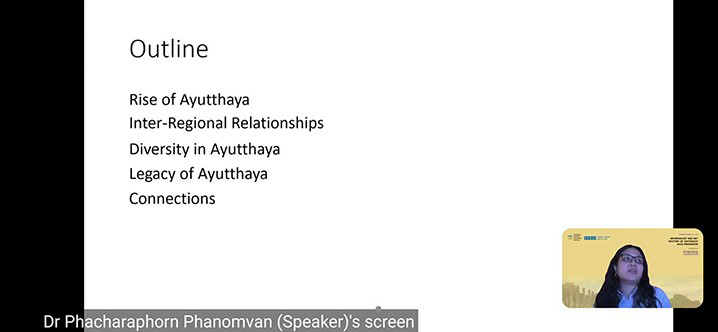
This lecture introduces the audience to the rise of Ayutthaya, from a small city state to its expansionist heights, decline in the late 18th century, and eventual transition and its roles in shaping contemporary Chao Phaya Delta identity. We will be looking at Ayutthaya’s urban and material culture network, and its spread across the South China Sea and the Indian Ocean. The lecture will also introduce how quasi-international cosmopolitanism in different Ayutthaya cities led to diverse material identities, particularly fine arts and cuisine. It will also explore the much overlooked subject of the Tai-speaking diaspora and its relationship with Ayutthaya as it rose to power and eventually declined.
Highlights
In this webinar, Dr Pacharaphorn Phanomvan introduces the audience to the rise of Ayutthaya, from a small city-state to its expansionist heights, decline in the late 18th century, and eventual transition and its roles in shaping contemporary Chao Phaya Delta identity.
Wednesday, 20 October 2021 – The ISEAS – Yusof Ishak Institute hosted a webinar titled “Ayutthaya: Urban Networks and Global Connections” by Dr Pacharaphorn Phanomvan, an economic historian and heritage scholar who works on development projects in Thailand and Myanmar. The webinar was part of the Temasek History Research Centre’s Archaeology and Art History Programme of Southeast Asia and was moderated by one of the programme’s conveners, Dr Noel Hidalgo Tan.
Moving away from the usual discussions of Ayutthaya as a UNESCO world heritage site and ancient Siamese capital, Phacharaphorn presented the kingdom as cosmopolitan conglomeration and how its presence is still felt today in contemporary Thai society. She explained the formation and rise of Ayutthaya as a merging of existing urban power centres around the Tha Chin River, Lower Chao Phraya, Isthmian Peninsular and the Yom-Wang, and Kok River during the 14th century.
By the 15th century, the Ayutthaya governance system, “hua-muang”, consisted of inner, outer and tributary cities, and after annexation of Sukhothai in 1463 a bureaucratic reform was necessary to more efficiently rule over territories over wide spaces. Even with contending and shifting power centres, the kingdom lasted under the reign of 33 kings over five dynasties.
A second aspect of Ayutthaya highlighted by Phacharaphorn was the cosmopolitan nature of the kingdom, such that by the 17th century the kingdom already had permanent settlements for foreigners such as the French, Chinese and the Persians. From the 15-16th centuries, the Persians and South Asians brought to the kingdom new forms of craftsmanship, clothing and Islam and their influences can be seen in architecture and art. From nearer in the region, the Mons, who had always lived around the Chao Phraya region, moved to Ayutthaya especially after the fall of Hanthawaddy.
Even after the fall of Ayutthaya in 1767 by Burmese conquest, Ayutthayan culture persisted through migrants and refugees. Phacharaphorn showed how Ayutthaya is still very much alive today in architectural remnants found in the outer cities of Ayutthaya – present-day Petchaburi, Samut Sakhon, Samut Songkram, Chonburi, old Phrapadaeng (present day Klong Teoi harbour) and Nakhon Sawan province. Ayutthaya’s influence today can also be felt in its role in establishing Thai literature and textbooks, the performing arts, food, and laws.
A lively Question and Answer session followed, with many questions related to the cosmopolitanism of Ayutthaya such as the interactions of different foreigners and the languages spoken in Ayutthaya. The webinar was attended by 149 participants, mainly from Singapore, the rest of Southeast Asia and the United States.

Heritage Policy Consultant
Webinar 9, November 1, 2021
Explore the rich traditions of Southeast Asian art with experts Mr Eko Bastiawan, Dr Mathilde Mechling, and Dr Heidi Tan as they unravel the mysteries of ancient bronze sculptures and the evolution of ceramics. From the sacred bronzes of Java to the innovative ceramic traditions across the region, learn how these art forms reflect the dynamic exchanges and unique developments in this culturally rich area.
An Introduction to Buddhist and Hindu Bronze Sculpture in Southeast Asia with a Case Study on Javanese Bronzes (6th-15th century), by Dr Mathilde Mechling and Mr Eko Bastiawan
Bronze – an alloy of copper and tin – has been used since the prehistoric period in Southeast Asia for everyday objects as well as for sacred and ritual art objects. In this lecture, we will introduce the simultaneous development of Buddhist and Hindu bronze sculpture in mainland and maritime Southeast Asia from the 6th century onwards. These bronze statues were both artistic representations of deities and consecrated objects, investing them with the living presence of the divine. We will see that while some small statuettes circulated with pilgrims travelling via the region’s maritime trade routes, the larger statues functioned within temples, commissioned by powerful political elites. We will explore how their religious nature and the context of their use impacted the fabrication techniques employed by craftsmen, and how stylistic exchange developed between Southeast Asian regions, as well as with India and China. Finally, utilising groups of bronzes forming maṇḍalas, we will investigate how bronze sculptures in Central and East Java evolved over a period of time.
Introduction to Ceramics in Southeast Asia, by Dr Heidi Tan
Why are ceramics so ubiquitous in the study of Southeast Asian art history and material culture? The art historian William Willetts identified ceramics (and textiles) as the most “elemental inventions” in this region (Brown 1988). This lecture will introduce innovative moments in the development of the region’s ceramic traditions. Drawing extensively on examples from regional museum collections, we will explore some of the major discoveries from land and marine archaeological sites. We will ask how ceramics functioned as commodities and carriers of cultural significance, and what they tell us about potters and end-users from as early as 4,000 years ago. We will also look at technological and stylistic developments in relation to imported ceramics from China and other regions from the late first millennium CE onwards, and how local kilns subsequently mass-produced and distributed large quantities of ceramics via the region’s maritime trade routes. And finally, the enduring legacy of these rich ceramic traditions will be discussed, as they exist today in ritual practices and the local knowledge of potters, collectors and consumers of ceramics.
Highlights
In the ninth webinar of the webinar series, Dr Mathilde Mechling, Mr Eko Bastiawan and Dr Heidi Tan spoke on the Buddhist and Hindu Bronze Sculpture in Southeast Asia and Ceramics in Southeast Asia.
Monday, 1 November 2021 – The ISEAS – Yusof Ishak Institute hosted a webinar titled “Introduction to Ceramics in Southeast Asia & An Introduction to Buddhist and Hindu Bronze Sculpture in Southeast Asia with a Case Study on Javanese Bronzes (6th-15th century) ” by Dr Heidi Tan, a ceramic expert and curator, as well as Mr Eko Bastiawan and Dr Mathilde Mechling, both Southeast Asia bronze art experts. The webinar was part of the Temasek History Research Centre’s Archaeology and Art History of Southeast Asia Programme and was moderated by one of the programme’s conveners Dr Hélène Njoto.
This webinar was divided into two parts; the first was dedicated to bronze statuary and the second to ceramics. Dr Mathilde Mechling kicked off with a brief introduction to the constitutive materials of bronze. She explained how bronze was used to produce sacred and ritual art objects since the prehistoric period, but the presentation focused on Buddhist and Hindu bronze sculpture from the 6th c. onwards. She then dived into more technical explanations on the fabrication techniques of bronze statuary (the lost-wax technique mainly), as well as research techniques used to study bronze art (archaeometallurgy). She showed examples of large bronze statues from Java, Cambodia, and the Thai-Malay Peninsula. Dr Mechling demonstrated that smaller statues have been preserved in larger number in Southeast Asia, and that their function varied from that of the larger images. Bronze images evidence interregional exchanges with India and China through an analysis of their style and geographical distribution. In some cases, the direction of exchanges from India to Southeast Asia may be challenged. For example, the bronze standing Buddhas with pleated robes traditionally associated with the so-called Indian “Amaravati style” are found in larger number in Southeast Asia and Sri Lanka, while only one is known at Amaravati, which suggests that these statues may not have come from India.
Mr Eko Bastiawan followed up with a presentation on Javanese bronzes, which styles are rather unique and can be found in Indonesian collections as well as in Europe and the US.
One significant type of bronze statue is the “Nganjuk type” which comprises 99 small statues. This set was identified as the Vajradhatu mandala by Anandagarbha, found in other places such as Tibet and bringing further evidence of Java’s connectedness with other regions of Asia from an early period on.
Mr Eko Bastiawan completed the first presentation about stylistic features, by underlining that to ascertain dates of bronze, identification of physical features is equally important. He took the example of a Four faced Vairocana where a Kala head is represented without any lower jaw, a feature typical of Central Java. However, this Kala has horns, a feature more prominent in East Java, which could indicate that the statue was created during the transition period from Central to East Java. Mr Eko Bastiawan provided further examples of ornamentation and physical features as tools for dating a statue: the spiky ornamentation such as the heavy jewellery worn by statues (armbands/bracelets, double necklaces etc.), the dramatic poses of deities, the strands of hair, the curl of ribbon, etc. This spiky ornamentation, typical of East Javanese statuary, shows a clear contrast with the gentler and still posture of Central Javanese statuary.
In the second part of the webinar, Dr Heidi Tan introduced ceramics in Southeast Asia, starting with a focus on the unique technological attributes such as types of clay, methods of production and firing during the first millennium CE. Dr Tan demonstrated how locally innovative ceramic traditions emerged at this time. These included elaborately decorated earthenware with combed, impressed, and applied decoration (3rd-5th c, southern Vietnam), and architectural as well as sculptural reliefs for Pyu (7th-8th c) and Dvaravati period (c.9th c) temples. High-fired glazed stoneware with ash-glaze was another innovation in evidence in the Kulen Mountains (Cambodia c. late 9th c). Glaze technologies flourished during the 11th to 13th centuries for domestic and export markets in northern Vietnam, Thailand and Myanmar and underglaze cobalt blue painted decoration developed in Vietnam were exported throughout the region during the ‘Ming Gap’ (14th-15th c.). Customised ceramics were used at sacred sites such as Vietnamese blue-and-white tiles for Islamic religious architecture in Java and unique lead-glazed earthenware tiles made locally for temples in Mrauk U, Myanmar. In this context, Dr Tan demonstrated that porcelain donations also served as merit-making objects, as can still be seen in Thai and Burmese temples and pagoda museums. In some places, trustees and monks still have a duty to take care of these objects valued as sacred.
The webinar was attended by 186 attendees mainly from across Asia but also from Europe and Australia. Questions varied from the meaning behind the difference of size, periods and subjects regarding bronze art across Asia, to technical issues regarding casting and archaeometallurgy. The public was also curious about the use of ceramics in architectural décor in Indonesia, as well as technical issues related to the production of blue and white Chinese porcelain and Vietnamese ceramics.

Post-doctoral researcher, École Pratique des Hautes Études, Paris

Independent researcher, Malang, Indonesia

Lecturer in Curating and Museology, SOAS University of London
Webinar 10, November 17, 2021
Explore the rich history of Đại Việt with Mr. Do Truong Giang as he presents the kingdom’s architectural marvels and cultural landmarks. From the Thăng Long citadel to the exquisite ceramics that sailed across the South China Sea, delve into the legacy of the Ly, Tran, Hồ, and Lê dynasties that shaped Đại Việt’s identity.
After regaining independence from China in the 10th century, Đại Việt became a powerful kingdom in Southeast Asia and considered itself a Smaller Dragon in the South. This talk introduces Đại Việt civilisation during its heyday in the Ly, Tran, Hồ, and Lê sơ dynasties (10th-16th centuries) based on recent archaeological advancement. I will introduce the Đại Việt State through the Đại Việt’s Imperial Capitals, the Thăng Long citadel (present-day in Hanoi), the Hồ Citadel (Thanh Hóa province), and the royal architectural system from the Ly, Tran, Ho, and Le dynasties. I will also cover the influence and imprint of Buddhism and Confucianism on Đại Việt society as seen from historical and archaeological documents, and finally the production and exportation of Đại Việt’s ceramics in the 11th-16th centuries.
Highlights
In the tenth webinar in the webinar series, Mr Alex Do Truong Giang gave an introduction to the Đại Việt’s Imperial Capitals and the royal architectural system from the Ly, Tran, Ho, and Le dynasties, he also shared on the archaeological site of Thăng Long citadel, located in present-day Hanoi.
Wednesday, 17 November 2021 – The ISEAS – Yusof Ishak Institute hosted Mr Do Truong Giang of the Institute of Imperial Citadel Studies of the Vietnam Academy of Social Sciences in a webinar titled “Digging Up Dai Viet’s Glorious Past: An Introduction to Archaeology and Arts of Ancient Vietnam”. This webinar was part of the Temasek History Research Centre’s Archaeology and Art History Programme of Southeast Asia covering the major kingdoms and material cultures of Southeast Asia over the last 1,000 years and was moderated by one of the programme’s conveners, Dr Noel Hidalgo Tan.
The presentation centred around the ancient capital of Thăng Long, present-day Hanoi, which succeeded the first capital of Hoa Lu in Ninh Binh province in 1010 CE. For 800 years, Thăng Long was the seat of power for the Dai Viet (Great Viet) until the Nguyen Dynasty made a new capital Huế, Central Vietnam. Mr Giang focused his attention on the glorious periods of the Lý, Trần and Lê Dynasties (11-15th centuries CE).
Archaeological excavations conducted over the past two decades at the site of the Thang Long Citadel have revealed extensive remains of the royal citadel and palace architecture associated with the palaces, Lý, Trần and Lê Dynasties including foundational structures, wells, brickwork, roof tiles and various ceramic pieces. The remains of the imperial citadel were recognised as Unesco World Heritage in 2010, while the finds from Vietnam National Assembly building are now displayed in an on-site museum.
Mr Giang also shared a video of a digital reconstruction of the Lý dynasty palace which during its time was painted red. In the second part of his talk, Mr Giang spoke about the production of ceramics in Vietnam during the 14-15th centuries. The Thang Long kilns produced exquisite pieces for royal and Buddhist use but also in this period a variety of Vietnamese kilns produced different kinds of wares, some of which can be seen at the Asian Civilisations Museum in Singapore.
In the 15th century, production and distribution of Vietnamese ceramics greatly increased in conjunction with the so-called “Ming Gap”. The extent of the Vietnamese ceramic industry during this period can be inferred from the Cu Lao Cham shipwreck which was recovered between 1997-2000 off the coast of Quang Nam. This shipwreck yielded more than 240,000 objects, most of which were Vietnamese ceramics. At the same time, finds of Vietnamese ceramics in the Philippines, Indonesia, Malaysia and Thailand confirm their distribution in the region as well.
The webinar was attended by 129 people, mostly from Singapore and within the region. Ceramics was the decided theme for the question and answer session, as most questions were related to the different types of ceramics on display at the presentation, and in particular, roof tiles.

Head of Department of Information and International Cooperation, Institute of Imperial Citadel Studies, Vietnam Academy of Social Sciences
Webinar 11, December 1, 2021
Join Ms. Noorashikin binte Zulkifli in uncovering the intricate layers of Islamic art in Southeast Asia, as represented in the Asian Civilisations Museum. Through an array of artefacts, including the notable finds from the Belitung shipwreck, explore the longstanding Islamic heritage that has shaped the region’s artistic and cultural landscape, highlighting the unique blend of local craftsmanship and Islamic motifs.
Southeast Asia today is home to around one quarter of the world’s Muslim population. With majorities in Brunei, Malaysia, and Indonesia, and significant minorities in Singapore, Cambodia, Myanmar, Thailand, and the Philippines, Muslims make up just under half of the region’s population. But Islam’s presence is not just of contemporary significance. The Asian Civilisations Museum’s (ACM) galleries kick off with the finds from the wreck of a 9th century CE Arabian dhow that were recovered off Belitung – proof of Southeast Asia’s early contact with Islam. Ensuing Islamic encounters led to the establishment of the first sultanate in northern Sumatra by the late 13th century CE. Despite its long history, Islamic art has been understudied and underappreciated. From the ‘ethnographic’ material collected during the Raffles Museum period (ACM’s predecessor) to the ACM’s recent acquisitions, we explore a variety of materials – textiles, metalwork, woodcarving and manuscripts – for insights into patterns of cultural exchange as well as influences from within the region and with the wider Islamic world.
Highlights
In this webinar session, Ms Noorashikin binte Zulkifli presented on the topic of Islamic art in Southeast Asia, showcasing collections and recent acquisitions from the Asian Civilisations Museum in Singapore. These art forms, mostly developed in Island Southeast Asia, serve as records of the way Islam was adapted to local knowledge and craftsmanship.
Wednesday, 1 December 2021 – The ISEAS – Yusof Ishak Institute hosted a webinar titled “Discovering Islamic Southeast Asia in the Asian Civilisations Museum Collection” by Ms Noorashikin binte Zulkifli (Asian Civilisations Museum, Singapore), a curator specialising in Southeast Asian Islamic Art. The webinar was part of the Temasek History Research Centre’s Archaeology and Art History of Southeast Asia Programme and was moderated by one of the two programme’s conveners Dr Noel Hidalgo Tan.
The webinar session kicked off with the poll question “What do you think of when it comes to Islamic art?” Ms Noorashikin offered the audience a choice of more than one answer ranging from calligraphy & manuscripts, talismanic objects, paintings & drawings, figures & sculptures, geometric patterns, architecture, ban of figural representation, arabesque/floral motifs, sacred/ritual objects, scientific/other instruments. Ms Noorashikin demonstrated, through an overview of the ACM collections, how Southeast Asia’s articulations of Islamic art often contrasted with art forms from other parts of the Islamic world. A great variety of materials were shown, from textiles, to metalwork, woodcarving and manuscripts, mainly from countries across Island Southeast Asia.
This presentation was divided into two parts. In the first part Ms Noorashikin showed how scriptures, mostly Arabic calligraphy, were prevalent in the region’s Islamic material culture. The second part introduced artefacts representing nature and mythical beings.
Among artefacts bearing scriptures, categories such as wooden doors and ceremonial hangings are not rare. They are used to distinguish between public and sacred space. On a room divider, the ship or boat motif composed of calligraphy is depicted – a symbol that can be found on other object types.
Manuscript illuminations stand among the finest artistic traditions in the region, witness to the social history and history of the religious life of Malay Muslims. Trengganu, on the East coast of the Malay peninsula, is the region generally accepted as having produced among the most sophisticated illuminations, with a rich colour scheme, compared to Acehnese or Javanese manuscripts. A Quran from West Sulawesi, recently acquired by the Museum, bears evidence of the Trengganu style emulation, just across the straits of Malaka.
Ms Noorashikin presented other artefacts where Arabic calligraphy is used such as a refined Quran chess with Arabic inscriptions, which style is associated with Myanmar Buddhist chess traditions. Another such example of an artefact with calligraphy can be found among Chinese exported wares, such as one particular 17th c. large Zhangzhou dish believed to be commissioned for the Acehnese sultanate with nine circles bearing inscriptions from the Quran and references to Ali, indicating a Shia leaning.
Seals, textiles and grave markers also count among the many artefacts central to Islamic material culture. Highlighting one particular grave marker, Ms Noorashikin noted they are seldom inscribed, but a wooden grave marker from Kutai, kept at the ACM bears a Quranic verse with delicate floral and vegetal ornaments.
In the second part of her presentation, Ms Noorashikin showed objects depicting nature and living or mythical beings, whether in figurative or abstract styles. A prevalent form in Southeast Asian Islamic material culture, but unusual for the Islamic world, is the al-Buraq mythical animal, as depicted in ceremonial hanging cloths from Sumatra, or in Southern Philippines in three dimensions in funerary context. Reminding the audience that Islam spread further beyond the Malay world and reached other communities than the Malays, she showed a ceremonial cloth from Lombok with Arabic calligraphy framed by human figures, bringing further evidence of the way Islamic teachings were adapted through local knowledge and traditions.
Wayang, although not necessarily associated with Islam, was another way to introduce Islam in the region. Bima and Dewa Ruci are two figures, respectively of the Hindu and Javanese mythology, used to spread Islamic teachings through popular performance, adapting to local forms, as experienced recently in Singapore‘s Kampong Gelam, with the Sultan Mosque in the background. Other mythical animal motifs found in the Islamic culture are the Makara, used as palanquin ornament in 18th century Patani, for example, to parade young boys during their circumcision ceremony. As shown by Ms Noorashikin, this rite of passage ceremony could still be witnessed until the mid-20th century in Kelantan and Patani as seen from old pictures.
This presentation was attended by 144 participants from all over Asia, Australia, Southeast Asia and Singapore. Many questions were asked to Ms Noorashikin. Some questions addressed calligraphy and script styles, the religion of craftsmen, Muslim divination manuals, the meaning of talismanic shirts and cloths, Southeast Asian glass and ceramic export for the Middle East, and a few other questions about the origin of the Buraq motif.

Senior Curator, Asian Civilisations Museum, Singapore
Webinar 12, December 15, 2021
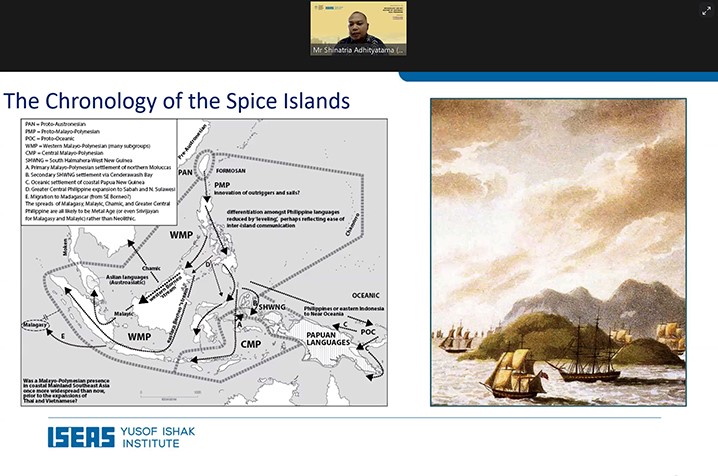
Mr. Shinatria Adhityatama unveils the pivotal role of the Spice Islands in shaping global trade and cultural exchanges from ancient times. Learn about the fascinating archaeological discoveries that highlight the Nusantara people’s contributions to spice production, shipbuilding, and how these interactions forged the identity of the Indonesian nation amidst the surge of international trade.
The Spice Islands, located in Eastern Indonesia, were once a key destination for traders. The prices of spices escalated in the early 13th century in response to demand from the global market, triggering competition between nations to monopolise this commodity. The Spice Islands and spice route cannot be separated from the Nusantara people. The role of the Nusantara people in producing spices and advancing shipbuilding technology shaped the way in which this commodity entered the global market. Conversely, the local presence of international traders shaped the cultural development from which the identity of the Indonesian nation arose. Ultimately, the spice route was more than a maritime trade route, but also a series of cultural, ideological, and even religious exchanges. This presentation will provide an overview of the spice route and how the local community played a role in managing the spices that were in global demand, as well as their socio-cultural and political impact based on archaeological finds.
Highlights
In the second last webinar in this webinar series, Mr Shinatria Adhityatama gives an overview of the spice route and how the local community played a role in managing the spices that were in global demand.
15 December 2021, Wednesday – The ISEAS – Yusof Ishak Institute hosted a webinar titled “Journey to The Centre of The World: Introduction to Spice Island Archaeology” by Mr Shinatria Adhityatama, a graduate student at the Griffith Centre for Social and Cultural Research in Griffith University, Australia and previously a maritime archaeologist at the Indonesian Research Centre for Archaeology (PUSLIT ARKENAS). The webinar was part of the Temasek History Research Centre’s Archaeology and Art History of Southeast Asia Programme and was moderated by one of the programme’s conveners, Dr Noel Hidalgo Tan.
Whereas previous webinars in the series focused on the archaeology of specific kingdoms in Southeast Asia in the second millennium CE, the focus of Mr Adhityatama’s talk was on the central role of the Spice Islands – the modern-day Indonesian provinces of Maluku and North Maluku – in the global system of trade in luxury goods and the arrival of the Europeans in the 15th century. Spices, in particular black pepper, cloves and nutmeg, have been prized since antiquity and archaeological evidence from Sumeria suggests that cloves were popular in Syria as early as 2,400 BCE which suggests the existence of a network that could facilitate the transfer of cloves from the Moluccas during those times.
By the first century BCE, there is more definite linguistic and archaeological evidence for long-distance maritime trade between China and the Middle East, connecting India and the Spice Islands. One key archaeological indicator for this maritime trade are boats. Mr Adhityatama showed examples of ancient watercraft that plied the Southeast Asian waters such as the 7th century Punjulharo boat and the Belitung shipwreck, noting that while much attention is paid to the ceramic cargo, spices would have been another important commodity that was in circulation.
Four important kingdoms of the Spice Islands were introduced. The Sultanates of Ternate and Tidore are probably the best-known in the Spice Islands, the former aligned to Portugal while the latter was aligned to Spain. The Jailolo Sultanate, established in the 13th century CE, was another centre of clove production and based in the island of Halmahera whose descendants continue to be customary leaders today. The Sultanate of Tanah Hitu was based on Ambon, and the island’s strategically central location attracted the Portuguese and the Dutch, the latter using it as the headquarters for the Dutch East India Company before it moved to Batavia.
The webinar rounded off with a presentation of two recent shipwreck discoveries in the waters of Tidore Island, which likely date to the 16 and 17th centuries. At Soasio, in the bay near the sultan’s palace and mosque, ceramics from two different periods of the Ming Dynasty were found, along with other Southeast Asian ceramics. At Tongowai, cannons and earthenware jars are linked to Macao and Portuguese origin.
The worldwide demand for spice as a luxury good and the resulting desire to control the production and distribution of spices from the Moluccas is why the Spice Islands can be considered as the ‘Centre of the World’. Archaeological remains show the waxing and waning influence of Islamic sultanates and Christian colonisers in this region, and today, Indonesia is promoting the cultural heritage of the Spice Route as part of its national identity.
In the Q&A session that followed the audience asked questions on literature related to the Spice Road and Japanese mercenaries in Southeast Asia. Over 130 participants attended the webinar.
PhD Candidate, School Of Humanities, Languages And Social Science, Griffith University, Australia
Webinar 13, January 5, 2022
Explore the historical and architectural landscape of Southeast Asian mosques with Dr. Imran bin Tajudeen. Delving into the unique styles that predate colonial influences, this lecture sheds light on the adaptation of indigenous building practices and ornamental motifs within the Islamic architectural tradition. Discover the fascinating dialogue between local cultures and the Islamic faith as reflected in the mosque designs of maritime Southeast Asia, and the ongoing debates surrounding their origins and evolution.
What were the historical forms of the Southeast Asian mosque? How many different types were there and how are they connected to local building conventions, ornamental schemes and material practices that pre-date Islam? This lecture focuses on Southeast Asian types that are distinct from the domed forms introduced during the 19th century by colonial architects. It examines key examples that have survived, as well as those that have long disappeared but are depicted in historical illustrations, and how symbols and meanings from the region’s older cult buildings were re-worked for the new religious context of Islam. It explores the connections to local and regional building customary practices as well as adaptations of earlier Indic conventions. The talk also retraces the trans-cultural connections across different regions that can be seen in some mosque designs, and the debates surrounding the origin and historical developments in mosque form in Southeast Asia. The discussion closes by looking at the last examples of the Southeast Asian mosque in the mid-20th century and their recent revivals.
Highlights
In this webinar session, Dr Imran Bin Tajudeen presented on the topic of Mosque architectural forms in Southeast Asia. These architectural forms are unique cultural inventions and landmarks mostly from Maritime Southeast Asia.
Wednesday, 5 January 2022 – The ISEAS – Yusof Ishak Institute hosted a webinar titled “Introduction to Southeast Asian Forms of Mosque Architecture” by Dr Imran Bin Tajudeen, a Senior Lecturer from the Department of Malay Studies and the Department of Communications and New Media, Faculty of Arts and Social Sciences. The webinar was part of the Temasek History Research Centre’s Archaeology and Art History of Southeast Asia Programme (AAHP) and was moderated by one of the two programme’s conveners, Dr Hélène Njoto..
The webinar session kicked off with four poll questions to gauge the audience’s familiarity with historical mosques from four parts of Southeast Asia, namely, Java, Sumatra, Peninsular Malaysia up to the Isthmus of Kra, and the eastern part of Indonesia. The poll findings showed greater familiarity with mosques from bigger cities in Java but also landmark mosques from other areas such as the Great Mosques of Palembang, Johor Bahru and Ternate.
The lecture was divided into three sections. The first addressed historiographical categories. The second section addressed the cultural and geographical context in which mosques were invented, and the third addressed the question of reinterpretation and revivals, localised Muslim cosmopolitanism and the limits of translation.
By introducing the historiographical and geographical contexts of mosques, Dr Imran bin Tajudeen showed that this built heritage primarily developed in maritime Southeast Asia, a region often excluded from Islamic art and architecture surveys, together with Southern Arabia, Southern India and Southern China. He also demonstrated that the categories used to define Southeast Asian mosques are often irrelevant. One of these irrelevant categories is vernacular architecture, architecture by and large in wood as opposed to classical or canonical stone or brick architecture. As he further showed in this lecture architectural variations of mosques in Southeast Asia are greater than usually thought, and wood is not the only material used to build mosques.
In Java, Sumatra and Southern Palembang alone, this great diversity is seen from the various forms, numbers, and functions of roofs, walls and platforms. In the mosque of Jepara, for example, the multiple roofs are used as true floors, unlike other mosques where multi-tiered roofs are superimposed primarily for ventilation, esthetical and religious purposes. Dr Imran further described the main types of roofs, within which even greater variability can be observed, such as the Tajug or pyramidal type, found in places from Champa to South Borneo (Banjar Mosque), Palembang (Masjid Agung), Melaka (Tanjung Keling) or Banten with its miniature tiers and Minangkabau mosques with their landmark gable on hip roofs. Dr Imran then explained how, despite these variations, some permanent architectural features, possibly inherited from the Hindu-Buddhist period, could be found throughout the region such as the finial (mustaka or momolo) used to decorate the summit of many of these Tajug mosques.
Dr Imran also showed other types of pre-Islamic forms of survival, such as the gable on hip, found in Kelantan, Teluk Manuk, Kota Bahru but also in Champa, also present in old temple reliefs such as Prambanan in Central Java. Another type is the hipped roof, found for example in Cirebon, Buton and Singapore (Khadijah and Hj Muhammad Saleh mosques), and finally, the gable type, seen in Patani’s Surau Aur and Melaka suraus or small mosques (such as at Tengkera and Banda Hilir).
In this introductory lecture, Dr Imran addressed the rich typology of mosques in Southeast Asia, a witness to trans-local circulations and recombination. He insisted on the fact that more research needed to be done since, besides the Java types, other regions of Southeast Asia have not yet been well studied. Each mosque has its own history of how it was created. Some mosques, such as in Aceh, built on top of stone bases, for example, carry much information on the way Aceh was trying to connect to other pre-Islamic Malay polities by emulating their built culture. Similarly, in Banten, gravestones were of the Acehnese type, and not that of its neighbouring Javanese polities.
This lecture was attended by 167 participants from all over Asia, Australia, Southeast Asia and Singapore. Many questions were asked such as the relationship between the mosque and the ruler’s palace and the meaning behind the layers of roof on the mosque. This final lecture marked the end of the AAHP series.

Senior Lecturer, Department of Malay Studies and Department of Architecture, National University of Singapore and Mutawa Visiting Fellow (2020-2021; 2022), Oxford Centre for Islamic Studies, UK